UX & Product
My thought processes before AI
Written in 2020, before AI tools were part of how I work — how I thought about UI/UX, landing pages and lead generation, using the persuasion slide model and a project of mine as the case study.
Written back in 2020. I wrote this for Enfection’s blog in April 2020, under the title The impact of perfect UI/UX on your lead gen campaign — long before AI tools were part of how I work. I’ve kept it as I wrote it, with only light tidying: a record of how I thought about design back then. The original is still on Enfection’s blog.
A step-by-step explanation of using the persuasion slide model, based on an internal case study: Metric Makers.
Did you know that a lead is the most important and valued asset in the world of a marketer? Do you know why it is often treasured by marketers? The answer is simple. It is because owning a quality lead is a hard task. It is necessary to conduct a lead generation campaign which has a perfect landing page in order to fulfil a marketer’s need. Being able to track data patterns always makes the life of a marketer easier, but with the assistance of a good UI/UX designer, marketers can reach their goals much more effectively! A perfect landing page, for example, is essential to conduct a great lead generation campaign.
The persuasion slide model by Roger Dooley is a great model which is applicable to sales, marketing or almost any other persuasive process. This model is especially useful because it helps you use specifically persuasive phrases that help increase user conversions. This article discusses how the persuasion slide model has been incorporated to explain the impact of UI/UX on lead generation.
Let’s take a look at the persuasion slide model
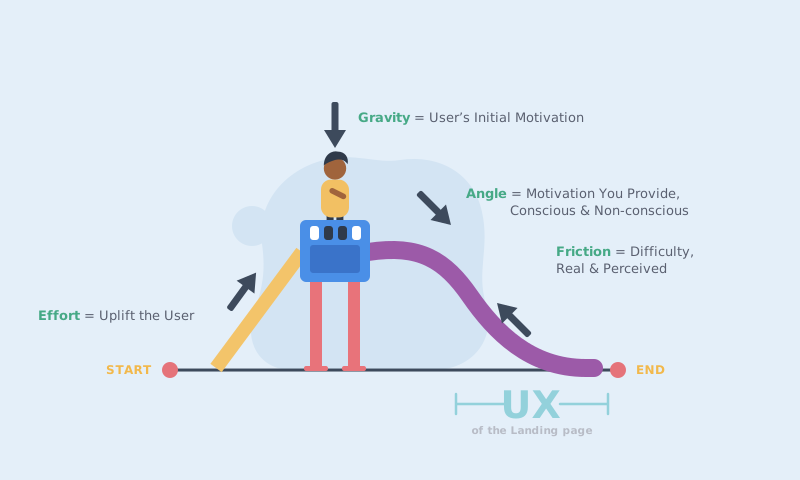
Effort = Uplift the user
Effort is essential for success in the field of marketing. Effort is required by the marketer and designer to help persuade the user to visit the landing page of a site. When getting a quality lead, it is always beneficial if the marketer has a sound knowledge of the target audience while the designer has the potential to design an artwork that has the power to attract and lead the user to click the link to the landing page.
Gravity = User’s initial motivation
Did you know that 37% of users will leave a website if they’re annoyed by the poor design? First impressions matter! Maintaining an attractive appearance is always important, as once the user lands on the landing page there should be a ‘wow’ factor which makes the user remain on the page. If you are able to do this, it builds trust within the user about the product. Great design and good content always help in this regard.
Angle = Motivation you provide, conscious and non-conscious
Here comes the most attentive part for the UI designer. In this process the UI/UX designer has to think about sensitive functionality of the UI. Check out a few tips below!
- Mobile responsiveness. In the world, most of the users now tend to browse the web via mobile phones. In this situation, it is always better to design the mobile phone version first.
- Impressive UI. UI helps to build trust and an impressive image of the product on users.
- Information architecture. Users should not be confused when they are landed on the landing page. Considering the flow of information is really important for leads.
- Easy form filling (error messages). In lead generation campaigns, form filling is the important part, as it is the tool which helps us collect the lead. If there is anything in the form which is not convenient for the user, then they will drop out.
- Right colour scheme and fonts.
Friction = Difficulty, real and perceived
In this section let’s talk about factors which affect the quality of a landing page.
- Loading speed. The performance of the server always matters with the speed of the landing page. So, it is important to connect the landing page onto a high-performance server.
- Backlinks. Backlinks deviate users from the direct landing on the landing page.
- Hard navigation. If there are confusing navigations like more CTA buttons, it will confuse the user. If we have a clear navigation and minimalist UI, then the users will stay on our page for a long period of time.
Finally, Angle > Friction
In this world nothing is 100% perfect. So, the angle also can’t be 100% perfect, and we can’t get the friction to 0% as well. In this process, if we can get an angle more than the friction, then there is a smooth journey within the process.
After going through all these steps, finally the marketer possesses the quality lead. Marketers consider quality leads as their treasure. Hunting this treasure is not an easy task. One can only succeed if that person follows the above explained process. During this treasure hunt, if you miss a single thing, you will lose it all. Each and every step has to be perfectly executed if you want to possess the treasure. This is why a marketer should always be supported by a good UI/UX designer.
Case study: Metric Makers, a project with successful UI/UX
Metric Makers is an online campaign carried out by our company. The world of marketing is constantly changing with new trends, and having a good flow with these trends is a plus point for marketers. Nevertheless, not all marketers are brave enough to dive deep into these trends and use them, except for a select few. So, we designed Metric Makers as an online platform for these brave marketers to share their experiences with budding marketers, to educate themselves on how to move forward with new trends and how to act upon them.
In order to address the needs of the user, I designed this online platform with an attractive and user-friendly UI/UX design, and did the front-end development. So, let’s see how I incorporated the persuasion slide model in this online platform.
Insight from the persuasion slide model
Effort = Uplift the user. This is the initial step of the process: effort. In the project Metric Makers, the keen knowledge of the marketer to address the correct audience and the powerful skills of the videographer controlled the effort successfully, directing users to land on the landing page.
Gravity = User’s initial motivation · Angle = Motivation you provide · Friction = Difficulty, real and perceived.
I used techniques like scroll-up transitions, image hovers and button hovers to increase user engagement. The platform is highly responsive on mobile and desktop interfaces, with the right information architecture and attractive typefaces and colour schemes, which increases its overall effectiveness. In addition to that, the friction of this platform is low because it is hosted on speedy servers, along with easy navigation.
Our success
The Metric Makers campaign was a great achievement for our company this year. We were able to track every single click within the page using our own product, Conversion Optimizer. We measured a total of over 700 site visits and 200+ visits per page over the campaign.
700+ site visits · 400+ mobile users · 200+ visits for each page
Conclusion
In the end, it is clear that leads are the most valued asset for a marketer. A marketer that possesses a quality lead can carry out a smooth lead generation campaign. This can be achieved through a smooth, effective and aesthetically appealing landing page. Hence, excellent UI/UX design is a marketer’s best friend.
UX & Product
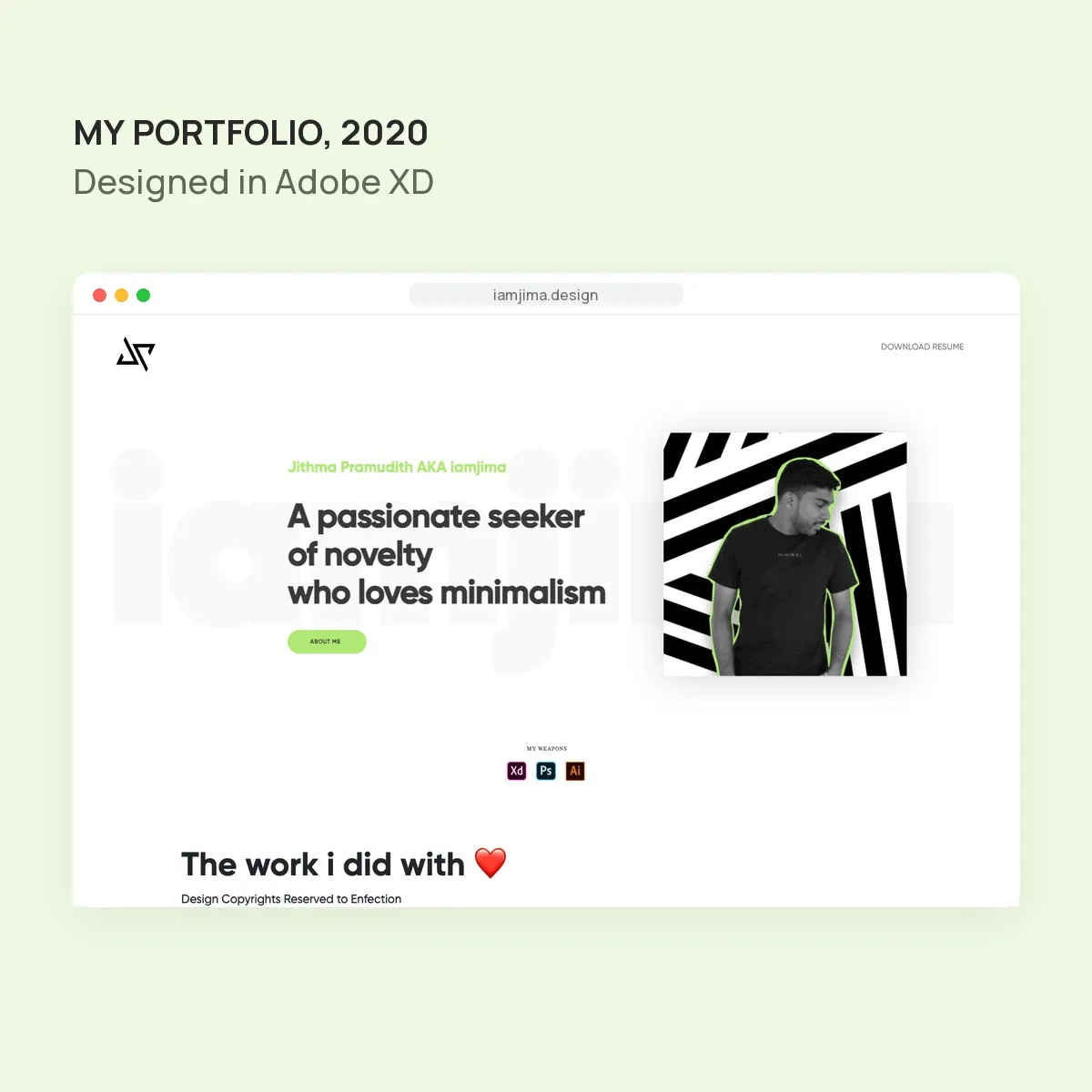
The portfolio that got me my second jobIn 2020 I designed my portfolio in Adobe XD and built it myself. It helped me land my second job. Here it is again, still running — and a little about the tool that started the next step of my journey.
UX & Product
Where I got my wingsVirtusa is where my UX journey really took off — four major projects in a year or two, cross-functional teams across time zones, and seniors whose lessons I still use on every project.
Journal
Fresh Start for the week...A 5.30am walk around the paddy field at Diyawanna Oya — cranes, lotus, kola kenda I didn't drink, and thinking about how much has changed in a year.